As ever, this is a highly complex and constantly evolving situation, so please do supplement with other sources. I’m going to start by giving you the context, then talk about where we are today, before giving a rought outlook on where I can see this heading.
The Context
Iranian protests reached a record peak in mid-January, in response to a weakening economic position that has left many Iranians struggling to afford basic necessities. You can read the full backstory in my 359 Briefing here: https://www.rahimhussain.co.uk/blog/2026-01-12-rahims-letter-024-359-briefing-on-iran, but one of the key takeaways there was the prospect of foreign intervention making this a significantly more dangerous situation for the regime than we’ve seen before.
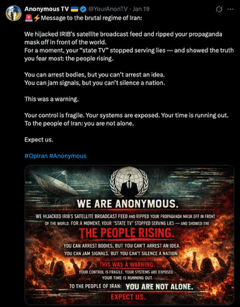
The Iranian government then imposed a curfew enforced by security forces, which put a stop to the mass protests we were seeing in the streets, where at least 27,000 protestors were arrested (some reports suggesting higher) and over 3,000 killed. There have been limited protests since, with the most notable event instead being a hack of the Iranian State Broadcaster, which briefly played footage of the exiled Crown Prince and encouraged security forces to turn their guns away from the people. Whilst an X account linked to Anonymous claimed responsibility for it (see below), it remains unclear who was actually behind it.
At the same time, the US has also been negotiating with Iran to try and reach a nuclear deal. For context, Trump withdrew the US from the Obama-orchestrated deal in 2018, and Iran subsequently withdrew in 2025. The US is reportedly now asking Iran to hand over 400kg of enriched uranium, stop developing nuclear weapons, limit its ballistic missile programme, and end support for its proxy groups such as the Houthis, as part of any deal. There has been a lot of back and forth - the Iranians initially said that “good progress” was being made, but then JD Vance accused them of not accepting Trump’s “red lines” and a deal looks no closer than before.
This sets the context militarily too, as US military assets have been building “an armada” around Iran for weeks, which I’ll focus on in more detail below. It’s also worth noting that Trump has been particularly critical of the UK in relation to the Chagos Islands deal, where we’re giving the Islands back to Mauritius but then effectively leasing back the largest island, Diego Garcia, which is home to a joint US-UK airbase.
Where We Are Today
So today - the Middle East is currently seeing the biggest build-up of military assets since the Iraq War, as shown in the graphic below.
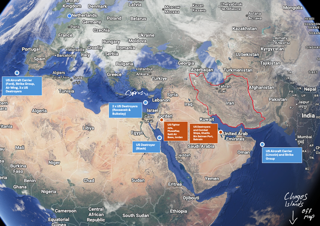
As you can see, there’s a significant amount of naval and aerial capability in the region. The aerial assets in particular have seen a massive airbridge this week, with FlightRadar data showing over 50 fighter jets (think the F-35, F-22, and F-16) being moved, as well as what seems like a constant stream of C-5 Galaxy and C-17 Globemaster cargo planes bringing military equipment into the region. Some of this seems to have included Reaper drones and both Patriot and THAAD air defence systems, which could help protect US assets in the event of short/medium-range missile attacks by Iran. A host of 16 air-to-air refuelling tankers are also in the region, as well as B2 bombers and six E3 Sentry aircraft.
These last three are particularly important.
- Air-to-air refuelling tankers let you go on for much longer, and open up the possibility of using bases and aircraft carriers further away from Iran for any potential action.
- B2 bombers are the aircraft used to drop the Massive Ordnance Penetrator (aka MOP) bombs used on Iran’s nuclear facilities last year, and are the only aircraft (that we know of) capable of doing so.
- And finally, the E3 Sentries are effectively flying headquarters that allow military leaders to see what’s going on below them and control the battlefield. One of these can run a war, so six is an exceptional amount of power to have on hand.
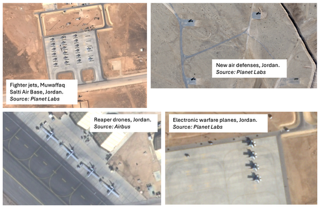
Some have suggested that this is purely leverage for the nuclear deal with Iran. I think that’s bullshit. You don’t move this much stuff around the world, at immense expense, whilst strategically weakening yourself on other fronts, just to make a point.
Earlier today, Trump said that they might make a deal in the next 10-15 days, or “very bad things will happen.”
By comparison, last year, on Thursday, June 19th, he said he’d make a decision on whether to strike Iran within the next two weeks. Overnight Saturday, June 21st/Sunday, June 22nd, Operation Midnight Hammer took place.
This feels very similar.
As an addendum, it’s also worth noting that the UK is reportedly now blocking US use of UK military bases for any Iran operation that may take place, which feels pretty remarkable and, speculatively, may be an indication that the UK is uncomfortable with the legal position of what they’re hearing the US may be planning. This relates particularly to Diego Garcia and RAF Fairford in Gloucestershire, which have supported US strikes in the Middle East in the past.
Where I Can See This Heading
These numbers below aren’t scientific at all. They’re mostly finger in the air and could be complete bollocks, but in a world where no one really knows what’s going to happen, it forces me to weigh up my views on the various possibilities. I would also caveat that I have an action bias, and so am likely to overweight big things happening sooner. I have tried to correct for this somewhat, but it definitely still feeds through.
60% Likelihood: US Strike on Iran between US market close evening of Fri 20th and Futures market open evening of Sun 22nd
I find it very difficult to see the US backing down from all this preparation without any kind of fight. The airbridge this week suggests to me it’s imminent, as you wouldn’t want to leave all that kit just lying there. Trump has been talking about this for nearly a month, and made a very similar warning to today’s last year. Whilst it’s somewhat military context dependent (they may not want to start in a thunderstorm), I would say it’s most likely to be after market close on Friday, and before the futures markets open on Sunday. The prospect of this being a prolonged military exercise remains, but I do expect they’ll claim some form of victory before futures markets open. It’s true that the USS Ford aircraft carrier will only get to south of Cyprus by Monday, but that’s if it’s travelling at normal speeds. I can see a world where a) it moves faster than normal and b) significant air-to-air refuelling capabilities mean it can be effective from further away.
30% Likelihood: US Strike on Iran between 22nd Feb and 5th Mar
If it’s not this weekend, I think it’s pretty much locked on to be in the next 15 days - Trump doesn’t really have an easy off-ramp to deescalation from here and he’s publicly announced those timelines (for now).
5% Likelihood: US Strike on Iran after 5th Mar
As above, I still find it difficult to see how Trump off-ramps from here - they could find a deal, but I don’t think his red lines are going to be acceptable to the Iranians. He also has a desire for regime change in Iran (saying late last week that “it would be the best thing that could happen”), despite limited day-after planning for what happens after that.
<5% Likelihood: No US Strike on Iran. Diplomacy prevails
This would be a wonderful outcome, but sadly, I can’t see it happening.
Now, an actual strike could take infinite forms. I’ve seen some frankly absurd suggestions that the US is going to drop a tactical nuclear weapon on Iran. Technically, yes, that is possible, and I’d posture that Moscow and Beijing probably wouldn’t fire retaliatory strikes in response for an obliterated Iran - but it sets a dreadful precedent, and I don’t think anyone is really on the verge of pressing the big red button, despite the US-Russia nuclear non-proliferation treaty expiring the other week. That’s almost definitely not what’s going to happen here.
More sensibly, it could be a small initial strike on strategic targets to force Iran into agreeing to Trump’s nuclear deal. If they still refused to agree, a broader campaign (likely alongside Israel, where the media has been claiming an attack is imminent since early January) to topple the Iranian regime would begin. For what it’s worth, I don’t expect that the Iranian government will submit after an attack.
Pushing them into a corner is dangerous because if they feel like they’ve got no way out, there’s no telling what they could do. Their military retains a significant arsenal of ballistic missiles that could hit targets across the Middle East and bordering countries, including Turkey, Iraq, Afghanistan, and Pakistan. Any regime change without clear succession also opens up the risk of widespread chaos in the region, which would provide a fertile feeding ground for even more nefarious actors.
If the US strikes, this might just be the start.
RH