The world hasn’t gotten any quieter since the last letter. Things seem to be bubbling, if not necessarily erupting, all over the world.
Here’s a shot at trying to get you a 359 on Greenland - there’s a bit on the tanker seizures at the very end too and the UK underwater cable threat.
1. Greenland
Let’s Start At The Top
The current position of the US government is that Greenland should be part of the United States.
Greenland is, of course, a self-governing territory of the Kingdom of Denmark. The US government would like to change that, either by buying it from the Danes or by taking it with military force.
Historical Context
There’s some historical precedent here. In 1941, the Nazis were on the verge of establishing an airbase on the southern tip of Greenland, having already conquered continental Denmark.
There was some talk of the UK or Canada occupying the island, but the US didn’t want to see a third nation take control in Greenland, seeing it as an extension of the Monroe Doctrine and the US sphere of influence.
So, against the wishes of his now-occupied government in Copenhagen, the Danish envoy to the US agreed a deal to form a US protectorate over the island.
This led to a mass inflow of US troops and military infrastructure, which never completely left.
When Denmark was liberated in 1945, the Danish government ratified the agreement, but slowly tried to take over US bases.
In 1947, the US then offered to buy Greenland for $100,000,000.
The Danes said no, but eventually signed a defence agreement in 1951, which allowed the US to keep existing and, with Danish permission, open new military bases on Greenland.
During the Cold War, this became critical to US national security, particularly thanks to the Thule Air Base (shown below, courtesy of Google Earth).
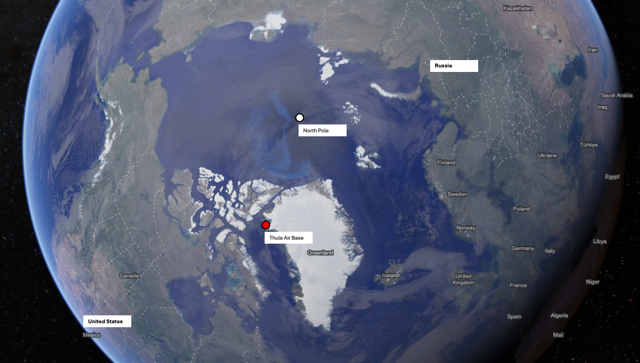
Now, if you’re trying to defend the United States against the USSR during the Cold War, having a radar station on Greenland means you can detect and intercept incoming USSR bombing raids, or intercontinental ballistic missiles fired over the Arctic from the Russian landmass or from submarines around the Arctic or North Atlantic.
And on the flip side, if you’re trying to maintain a nuclear deterrent that is capable of nuclear retaliation in the event of the destruction of the continental United States, attacks from Greenland are less likely to trigger USSR early warning systems vs attacks from the US’s long-range missiles in Europe.
The US also tried to build a series of mobile nuclear missile launchers that could survive a first strike under the Greenland ice sheet in the 60s, but this ultimately failed because of unstable ice conditions.
Thule is now the US Pituffik Space Base, where it remains on watch for intercontinental ballistic missiles, as well as the missile warning and tracking system Space Delta 4 (and others) on behalf of NATO. It would also be a critical place for NATO aircraft to refuel in the event of a war in the Arctic theatre.
It also holds a great naval position, giving you influence over the Greenland-Iceland-UK gap that Russian ships would have to pass through to get to the east coast of the United States - which is where the Bella 1 was picked up earlier today, albeit going the other way.
So, why does the US want Greenland?
Well, I don’t think it’s because of its military benefits. The US already has pretty wide-reaching access to build military infrastructure across the island, and the Danish government is hardly going to oppose US defence at a time when they’re pulling out of the rest of Europe.
I think it’s actually a trio of other strategic aims:
1) The US thinks Greenland is in its sphere of influence and so no one else should have a say
FDR saw the Monroe Doctrine expanding to Greenland, and I don’t think it’s a huge leap of faith to think that Trump doesn’t also see it this way, hence their statements about how it should be part of the United States.
There’s also a non-zero amount of ego in this administration and adding a territory of that size to the United States would definitely give it a big ego boost.
It would be the largest purchase of land in American history, even larger than the Louisiana Purchase, and the US would be the second biggest country in the world (after Russia), displacing Canada.
For a man that loves hyperbole, that’s gotta sound pretty attractive.
It also builds on the desire to establish American greatness in a tri-polar world where the US, Russia, and China dominate in their respective spheres of influence. Taking over Greenland would give the US a pretty big one up over the other two.
2) Secure access to Arctic shipping lanes
The Arctic is melting. This is opening up new shipping lanes around the North Pole that were previously frozen over, as shown in this great map from the Arctic Council.
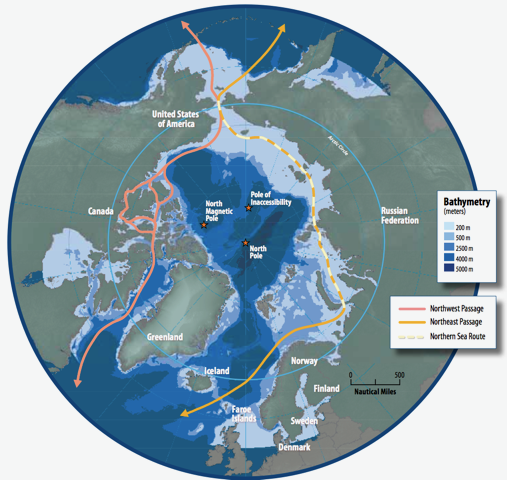
This is a much faster way to get from Western Europe to Eastern Asia, versus taking the Suez Canal (and to a lesser extent, Asia to the US East Coast via the Panama Canal). As more of this melts due to global warming, these routes are going to become even more popular and provide a lot of economic value to whoever has influence over them.
Russia pretty much has a monopoly, although the Chinese have also expressed an interest in developing an Ice Silk Road through it, seeing it as a safe option to ensure uninterrupted trade. Maritime traffic remains low relative to Suez, but is rising every year as it spends more of the year unfrozen, giving it a pretty compelling economic outlook.
Russia has also been expanding defence infrastructure along the route.
Currently, the US only really has access to the Northwest Passage, and even most of that is going across the top of Canada.
Enter, Greenland.
If Greenland is part of the US, they get a much stronger influence over the Northwest Passage, and can peer right on over at the Northeast Passage, the North Sea route, and Russian and Chinese activities along it.
3) Ensure ongoing access to Greenland’s minerals
This administration really likes minerals and rare earths. China currently dominates the global supply of these, and given their importance to pretty much everything from the lithium in your phone battery to the graphite used as dry lubricant in so many industrial applications, it makes sense that the US wants to control access to them.
Trump has shown a clear desire to secure mineral rights for the US to reduce this reliance on China and make sure that US companies can get “domestic” access to these materials.
These deals have formed a pretty significant part of the trade deals the US made over 2025, and aren’t looking like they’re going away anytime soon.
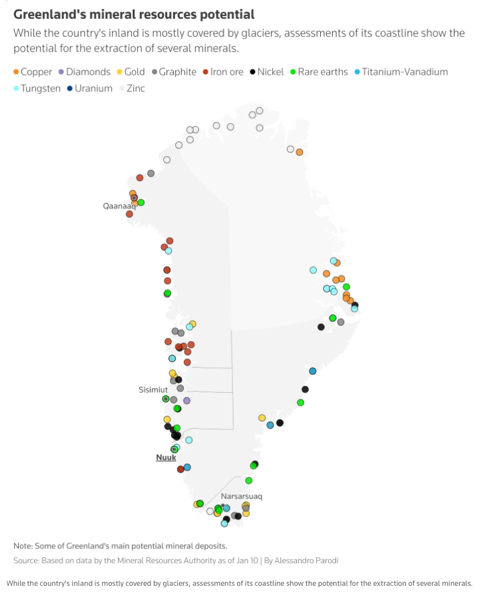
Greenland provides access to a plethora of minerals, as shown in this great map from Reuters. Scientists also suspect there are huge oil and gas reserves under Greenland, but over 50 years of drilling hasn’t been able to find anything.
Could They Buy It?
As I said at the very top, the two main ways being suggested at the minute are either by buying it or by military force.
The former seems to be the current default positioning of the US administration, with Secretary of State Marco Rubio meeting Danish officials next week, potentially with a new offer to buy Greenland.
The Danish position continues to be that Greenland is not for sale, and given the opposition of Greenlanders to US rule, I don’t see that changing anytime soon, and so it’s unlikely that any sale will be agreed soon.
Greenlanders do have a constitutional right to self-rule, and so if they voted for independence, that would be another route, but a vote for independence is not a vote for US rule. The US could begin an influence campaign to win public opinion, and has been making some inroads on this - in August, the Danish summoned the head of the US embassy in Copenhagen to complain about three Americans with links to President Trump running “covert influence operations” in Greenland. This followed reports in the spring that US intelligence agencies had been gathering information around the independence movement in Greenland.
But any campaign to win hearts and minds won’t be quick or easy.
Could They Invade It?
Yes. The US has also spoken publicly about not ruling out using military force to take it, a position they’ll be feeling bolder on following the military success of the Caracas raid.
They wouldn’t struggle to do this - Greenland is huge, but very sparsely populated, and a technical victory would probably be quite easy. It’s very difficult for Danish, or even wider European, forces to defend the whole landmass.
But then you fall into the Day After problem - with a population hugely against occupation, how would the US rule day-to-day life on the island? Resistance movements would quickly develop, and long-term occupation would not be pleasant for US personnel.
Winning hearts and minds won’t be easy in peacetime, never mind after an invasion.
And so, maybe the US will decide to send all the Greenlanders to Denmark. It sounds bonkers, but it’s a country of 58,000 people. The US deported 600,000 people at home last year.
This all feels like a lot of effort, especially for the three aims I’ve suggested above.
They already pretty much have free rein to do what they want militarily, and so perhaps this is all to build negotiating leverage for a minerals deal - but that hasn’t been the playbook for other minerals deals, and the spheres of influence point still holds, which is enough of a reason to make me think that it’s still a serious risk.
What Would That Mean For The World?
The ramifications would also be disastrous - the US will have invaded a sovereign nation, not least a treaty ally, that posed no threat to it.
33 Danish soldiers died in Afghanistan for the United States. 7 in Iraq.
Domestically, the US would erupt. Leading Republicans have already been pretty critical of his approach, and I suspect this could be enough for them to finally try to force him out of office.
Trump could invoke some clause (or a coup) to try and maintain power - would US institutions be able to stand up to it?
Or would they face the same thing the US Capitol did on Jan 6, 2021? Trump still defends the people who did that as Patriotic Americans.
Could it be the trigger point for a second US Civil War?
Denmark could trigger Article 5 of NATO. But NATO isn’t built for an internal attack - it didn’t get involved when Turkey and Greece fought over Cyprus in 1974.
Would the rest of Europe unite to criticise the US, let alone mount a military response?
On one hand, you get the prospect of Europe going to war with the US. That’s not going to happen. Militarily, Europe wouldn’t be able to sustain a war on that scale, and politically, economic warfare against the US would cripple the global economy and plunge the world into a deep and protracted recession.
But then on the flip side, Europe sits back and watches the destruction of the North Atlantic Treaty and the post-war security guarantee. Would Europe unite, or would it fall apart? Perhaps the US would also take up what was once centuries-old British foreign policy - to create a disunited Europe so it wouldn’t pose an existential threat to the British American Empire.
With NATO broken and fighting itself, that could present a pretty opportunity for Putin to expand his territorial ambitions to the Baltics. China could choose that moment to take Taiwan.
A lot could happen. Little would be good.
2. Venezuelan (or are they Russian) Oil Tankers + The UK Underwater Cable Threat
Slightly less heavy is the hot story of today - the US has seized two oil tankers that allegedly belong to a shadow fleet linked to Venezuelan oil. One was in the Caribbean and one in the North Atlantic - the latter is more consequential, so that’s what I’m going to focus on here.
The ship in the North Atlantic is now called the Marinera, but until recently was called the Bella 1 and is one of many ships used by Russia, Iran, and Venezuela to get around sanctions.
Now these ships are usually registered to smaller countries and will sometimes hop their registration between different companies to make it harder to trace back.
The Bella 1 is particularly interesting for a couple of reasons.
Firstly, the US Coastguard wanted to board it whilst it was in the Caribbean in December.
Apparently, it was sailing without a valid flag at the time, which means it was a stateless vessel and could’ve been boarded under international law. But the crew refused, and it’s been dodging the US Coastguard ever since.
Secondly, the crew then re-registered the ship in Russia.
It’s not entirely clear when, but it had previously been registered in Panama, Palau, Liberia, and the Marshall Islands - and changed its name to the Marinera. This seems to have been an attempt to put it under Russian protection - you can’t board a ship because it was stateless.
At the same time, you can’t really change the registration of a ship mid-voyage, and so it’s a bit of a legal wormhole that I’m sure there'll be much better analysis on.
Either way, it complicates matters. For the Americans, seizing the ship is then potentially a direct action against the Russians. For the Russians, protecting the ship undercuts the point that these ships aren’t meant to be directly linked to Russia (or Iran or any other country trying to avoid sanctions).
It seems the Russians cared about this particular ship, with some reports that Russia had sent a submarine to escort it back to Russia.
Clearly, this failed (some reports claim the sub didn’t get there in time - these are all unverified for now and are likely to remain that way) and the US boarded the ship this afternoon. They claim it was stateless, and that they’re seizing it under a warrant linked to sanctions evasion.
The Russians have called it “our vessel” but seem to have distanced themselves from it, saying it only temporary permission to fly under the Russian. I suspect there'll be a bit of noise in diplomatic circles around this, but on the whole, I expect this will go away sooner rather than later.
Given where it was, the UK also provided some military support. Defence Minister John Healey addressed the House at 7pm, calling it a continuing operation against the Russian shadow fleet.
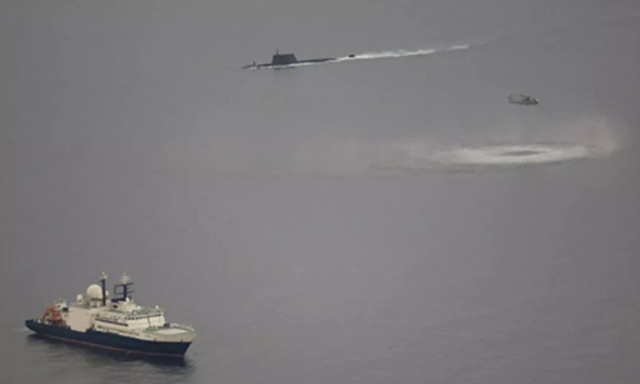
It’s no secret that the Russian shadow fleet has been increasingly proactive around UK waters. One example is the spyship the Yantar (the Russians call it an oceanic research vessel), which has a habit of hovering over our deep-water communications cables.
The ship is part of a Russian defence directorate for deep sea research, and it’s said that the ship could be mapping cables, or even planting sabotage devices that could be activated in a time of war. Towards the end of last year, they used lasers to disrupt RAF pilots tasked with tracking its activity.
And, whilst the public don’t know loads about what HM Forces are doing about this, I’m quietly confident in the Royal Navy’s ability to counter the Yantar.
After all, when the Yantar made its first appearance of 2025, the Royal Navy surfaced a nuclear submarine right next to it...
Seriously though, the cable problem is real. Wireless only really exists over short distances, like between your device and the nearest Wi-Fi box/mobile phone tower.
It then goes through telecommunications cables to one of the underwater connection points along the coast, and then underwater fibre-optic cables to mainland Europe, or the US where the bulk of main servers are. Submarinecablemap.com does a great job of showing where these are.
On the other end, the servers pick up your request, get the answer, and then send it back along the same cables, at pretty much the speed of light, until it gets to your Wi-Fi box or mobile phone tower and wirelessly pings back over to your phone.
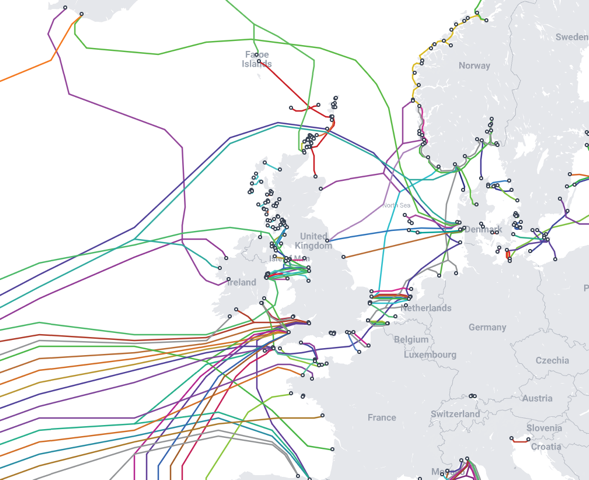
Now, you could use a satellite to get around this, a la Starlink but this is currently less than 1% of UK internet infrastructure.
So if the cables get cut, we lose the internet.
RH